Harriet, or, the Innocent Adultress
Harriet, or, The Innocent Adultress is a novel anonymously written and released in 1771. Its narrative split between two volumes, the eponymous protagonist is the youngest of three sisters in the modest Courtly family, who is married off to the wealthy and bodacious Lord Fillmore after an arrogantly persistent pursuit of her affection. She subsequently becomes entangled with the empathic Prince who, alongside her close acquaintance the Countess of D., observes that Harriet is experiencing continuous neglect from her callous husband, content with prioritizing the company of his upperclassmen peers in Newmarket over spending time with his newlywed. When the affair between Harriet and the Prince is made public, the former is put on trial under the presumption of committing adultery. This proceeding informs the story’s basis, as a series of exchanges between the prosecution and defense color in the narrative’s chronology by charting alleged sightings of the discreet pair at Kensington Parks, Carlisle House and the opera.
SETTING THE STAGE
The novel lacks a preface, a stark contrast to the oodles of paratext that lead into a similar tale of virtue such as Daniel Defoe’s Moll Flanders. Instead, the narrative begins in medias res, during Harriet’s trial. The back-and-forth between the defense and prosecution, presented through signed letters to the judge similar to an epistolary novel such as Pamela, serves a similar function by not only exemplifying the story’s foundation to the reader, but also divulging the subject matter. The defense makes a scathing remark towards the prosecution on page XXII, where he likens this individual to other “jealous husbands” with his narrow view on womanly virtue, and the unjust expectations placed on people like Harriet to be “chaste as ice–as pure as snow…” (1771, XXII). This condemnation spells the author’s views on women’s social vagrancy especially in the social climate that produced this work. In much the same way Defoe characterized Moll Flanders descending into deviance, The Innocent Adultress views virtuousness as placing too much burden on women to exercise an unrealistic fidelity towards their husbands despite facing neglect or mistreatment, in efforts to confine them to a domestic lifestyle.
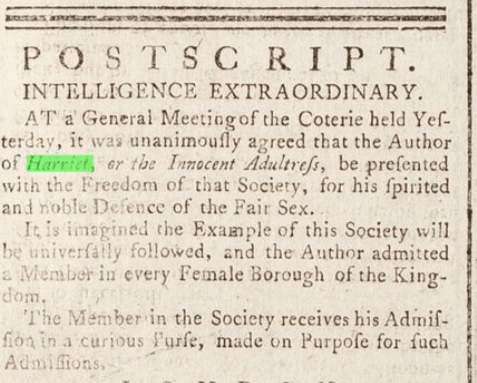
There is however, a postscript for the novel in the April 13-16, 1771 edition of the St. James Chronicle. It humorously predicts that the example the unnamed author provides of a “Noble Defence of the Fair Sex” will soon be unanimously embraced in society, and that the Author themselves will be integrated as a member in every female Borough of the Kingdom – presumably the U.K. – following its publication.
HARRIET HOLDS UP
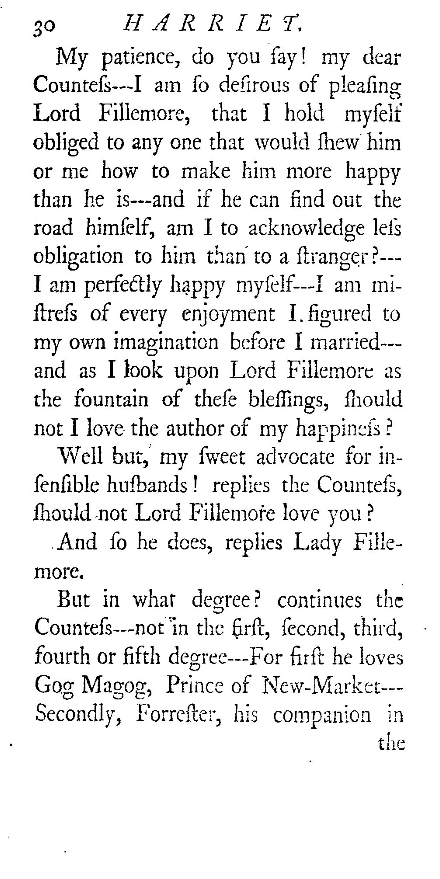
When reading the novel I was taken aback by how progressive the author’s philosophies were, especially having familiarized myself with other works of the eighteenth century that were similarly intended as forms of moral instruction. Harriet herself carries an agency that doesn’t predetermine her towards criminal behavior in the vein of a character like Defoe’s heroine, whose only depiction as a self-sufficient woman who isn’t motivated by a desire to marry or seek a husband, is when she has a brief tenure as a thief in collaboration with her Governess, which not only results in her punishment at Newgate Prison, but causes her to seek repentance by committing herself to domesticization, both by her Lanchshire husband and the plantation owned by her brother. Harriet does not seek happiness through marriage in the same way, as the earlier half of the novel details that Lord Fillemore is the pursuer in their union, describing himself to the comedically named steward Lord Macaroni, as “…in love, not for a day, but for my whole life–I burn with a flame that will not expire but with my last breath.” (1771, 9).
In Section III, Fillemore begins seeking Harriet’s hand in marriage through courting her father, but the novel surprisingly subverts the expectation that a man of modest standing such as Mr. Courtly, would be instantly seduced by the wealth flaunted by Fillemore, and prefers not to speak on behalf of what Harriet herself would want, encouraging Filemore to make his desire for Harriet known to her directly. The bonding between the pair is only initiated when Harriet is convinced to reciprocate Fillemore’s desires, which ascribes the former with an autonomy that isn’t encroached on by a party with controlling interest, nor is it relinquished with encouragement from external authority figures, and this decision therefore garners a certain sympathy towards Harriet when Fillemore himself becomes absent and unwilling to prioritize her company over the story’s duration. Moreover, the narrative illustrates that Harriet leaving Fillemore and forgoing the social expectations placed on her to remain faithful regardless of circumstance, is not only considered but encouraged as a more positive outcome for her wellbeing. In section VIII, the Countess of D. reasons with Harriet regarding Fillemore, humorously listing all of the individuals in the latter’s life that have taken precedence over Harriet despite their marriage, such as the Prince of Newmarket, his rider Tom Marshal, Macaroni, his groom, and so on, going as far as to reveal he had been seeing a young Duchess behind her back. Without the complete story reserved, it is impossible to know whether Fillemore’s infidelity was leveraged as evidence against the accusations of adultery leveled against Harriet in the trial that precedes the main narrative, but I found that the author harbored a very nuanced perspective on the factors that would motivate any woman of Harriet’s predicament towards such behavior, and I appreciated that the book refrained from coloring her beliefs and actions in a consistently discouraged light by refraining from glorifying the culture and activities partaken by people like Fillemore who grew up enjoying higher privileges, thereby finding their own behaviors acceptable even at the expense of people beneath them socially.
YET STILL, A SIGN OF THE TIMES
A byproduct of the author emphasizing the negligence Harriet endures is that until she meets the Prince, her skepticism against her peers’ observations were often written in a way that framed Harriet as more passive and accepting of her role as the domesticated wife. When Harriet is presented with the possibility of her husband’s ambivalence towards her, she surprisingly expresses awareness of this notion to the Countess of D., but is nevertheless brash in dismissing her concerns. As she puts it, “…my love for him is too fixed to leave room for a single reflexion that would give me an unworthy opinion of him…” (1771, 31). Harriet’s stagnation is another unfortunate consequence of the story’s second volume being lost to obscurity, but it no less detracts from my criticism that the author electing to have her remain in this predicament for half of the novel comes off as particularly regressive after establishing Harriet as having a certain agency in being able to choose what she felt was best for her wellbeing prior to being married to Fillemore, which distinguished her from characters such as Moll Flanders whose primary motive was rooted in the security more authoritative men could provide her.
MEET THE PLAYERS
HARRIET COURTLY
LORD FILLEMORE
COUNTESS OF D.
The main protagonist of the novel. She is the youngest of three children in the modest Courtly family and grew up drawing attention to many of the men local to her home, but becomes the object of particular affection for Lord Fillemore, who successfully arranges to marry her. Harriet is often described as an individual admirable to both sexes as a result of her conduct, particularly exemplifying a certain status due to her gentle nature and fashion. To her own detriment, she is so assured in her commitment to Lord Fillemore that she often doesn’t question his absence from her life in most aspects, as he prioritizes friends and acquaintances of his own social standing over his own wife, much to other people’s observations.
Harriet’s pursuer. He is described as coming from excess wealth in comparison to the more humble upbringing of the Courtly family, and has thus developed a narcissistic personality that is entangled with his deep infatuation and desire to ‘have’ Harriet as his wife, even likening her to a conquest akin to the siege of Troy in a passage (13-14). Despite this, the novel will reveal in due time that he is more complete without Harriet’s presence in his life, then he would perhaps let on in front of his peers in the upper class.
A young widower whose vivacity and good-hearted nature among those of her sex, gains the admiration of Harriet despite her intense quarreling with Lord Fillemore. The Countess notably remains astonished at Harriet’s devotion to her newly wed, as he himself grows progressively ambivalent towards her companionship and appears to prioritize attending parties with others of his status at Newmarket over continuing to communicate and engage with his own wife, even if Harriet herself appears to accept such a reality.
THE PRINCE
MR. COURTLY
CHARLOTTE
A young man who becomes infatuated with Harriet during her marriage to Lord Fillemore, and whom the Countess assists with winning her favor due to viewing his zeal and devotion to her as superior to her current husband.
Harriet’s father who retains a modest humility and often acts as the liaison between Fillemore and Harriet herself, though refuses to speak on behalf of his daughter’s wishes.
An old friend of Lord Fillemore whom he reconnects with during his excursions away from Harriet, and who introduces him to several other women he becomes entangled with–much to the unfortunate awareness and chagrin of Harriet’s acquaintances.
 Harriet, or, the Innocent Adultress