Harriet, or, the Innocent Adultress
About the Publishers
R. BALDWIN
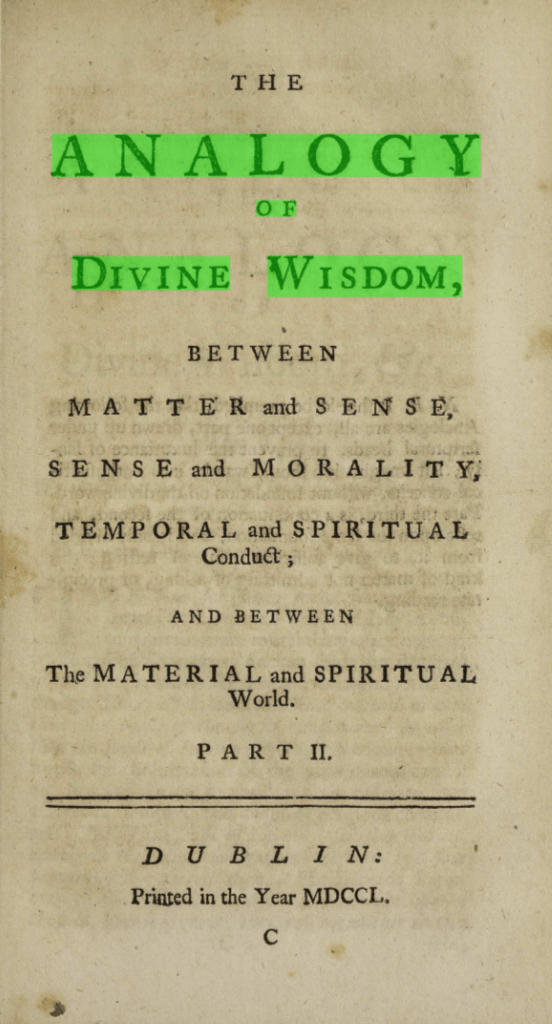
The work was originally published solely by R. Baldwin, who based on a search for works attributed to their distribution on both the ECCO and English Short Title Catalogue (ESTC) databases, appears to have amassed a bibliography of stories that concern themselves with religion and its intersection with topics such as human morality and virtuousness. Some excerpted works that surfaced during this search through their wider publication history included Bellamy D. ‘s The Christian Schoolmaster, which documented a series of accounts for the lives and activities of apostles and evangelists. John Stirling similarly wrote Cursus theologicus, a study of theology that attempted to condense the principles of religion as both a faith, and how its ideology is practically applied. A particular work from R. Baldwin that caught my eye was Phædrus’s Fables, a series of life lessons specifically for use in schools, implying they were primarily targeted towards, and intended to provide a form of moral education for children and teenagers, that would thereby inform classroom and life conduct. In June 1750, R. Baldwin also re-published Richard Barton’s Analogy of Divine Wisdom, an eight-part book exploring the namesake subject in a variety of material, moral, civil and spiritual systems, as well as the nature of morality itself and how to use reason in a Christian context.
J. BEW
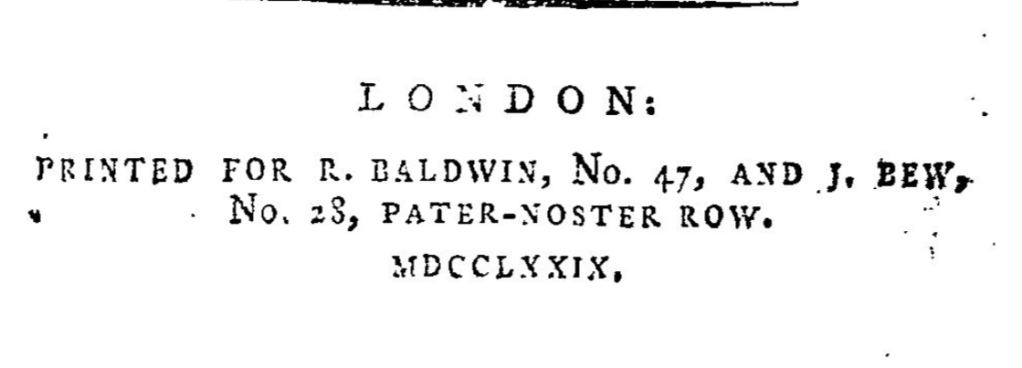
The 1779 edition of The Innocent Adultress however, was a co-publication between R. Baldwin and J. Bew. The latter’s wider bibliography did not appear to overlap significantly with the works R. Baldwin distributed; one title that immediately caught my interest when parsing the ESTC databases for more information, was Maria, or, the Obsequies of an Unfaithful Wife, published in London around 1750. The information available on the title itself is practically non-existent; the ESTC listing even details in the Notes that the “half-title” of the work itself appears to be abbreviated from a fuller name, and that information such as a verifiable place of publication are still disputed; the only surviving copy of this novel is archived at the Henry E. Huntington Library in San Marino, California. Based on the title alone however, it can be inferred that the narrative was much like Harriet, oriented around deconstructing womanly virtue as it was understood in the eighteenth century. ‘Obsequies’ is an Old English term synonymous with funeral rites, which furthermore implies that the story eulogizes the eponymous character’s life while correlating the circumstances of her passing to her alleged defiance of the social norms placed on someone of her status, in much the same way Harriet’s trial is used as a plot device to chart the character’s history and motives for potentially partaking in such vagrancy in The Innocent Adultress.
EXCERPTED WORKS
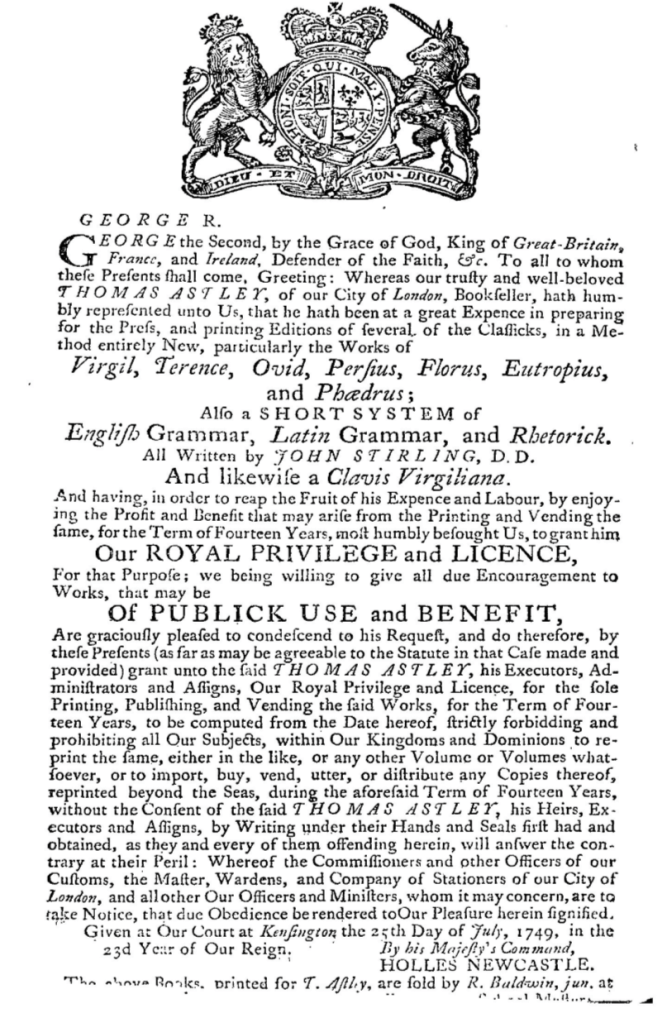
Phædrus’s Fables, a series of life lessons specifically for use in schools, implying they were primarily targeted towards, and intended to provide a form of moral education for children and teenagers, that would thereby inform classroom and life conduct.
In June 1750, R. Baldwin also re-published Richard Barton’s Analogy of Divine Wisdom, an eight-part book exploring the namesake subject in a variety of material, moral, civil and spiritual systems, as well as the nature of morality itself and how to use reason in a Christian context. As an example, Barton likens the attraction of cohesion towards the physical attraction of gravitation, as if to say that someone’s love of their country is theoretically stronger than a more general benevolence to all humanity, in the same way that a whole stone held in one’s hand is bound to gravity, even the portions that aren’t fully grasped, meaning the stronger principle of adhesion prevails (Barton 1750, 59).
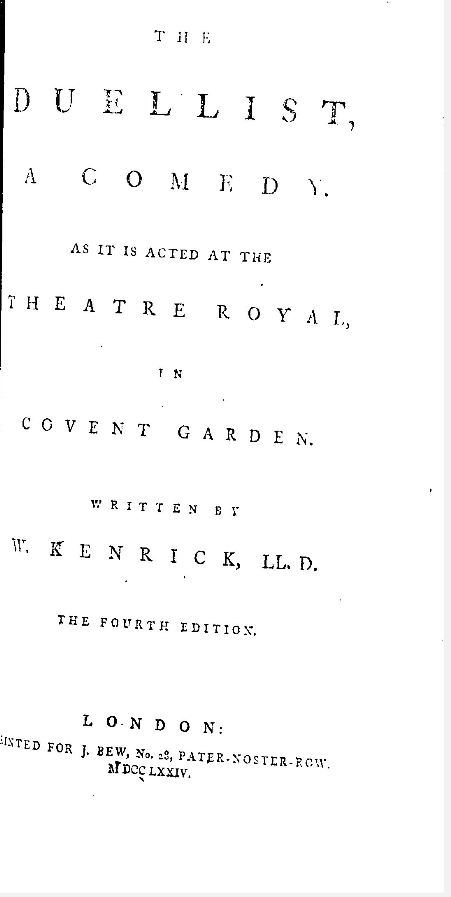
Only five years before co-publishing the ‘New Edition’ of The Innocent Adultress, J. Bew would release the fourth edition of The Duellist, seemingly a textual adaptation of a live-action comedy routine that was performed at the Theatre Royal in Covent Garden, located today in the West End of London, England. This again, exemplifies how disparate Harriet is from their wider, known bibliography, though the text’s levity in tone does have a correlation with the overall lighter portrayal of the serious subject matter that informs The Innocent Adultress‘ plot.
 Harriet, or, the Innocent Adultress