Harriet, or, the Innocent Adultress
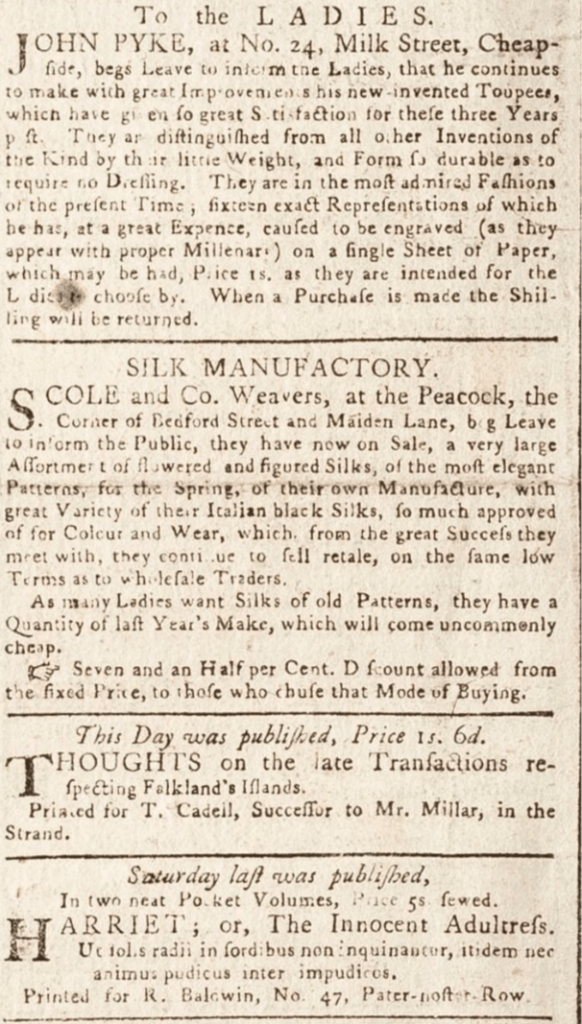
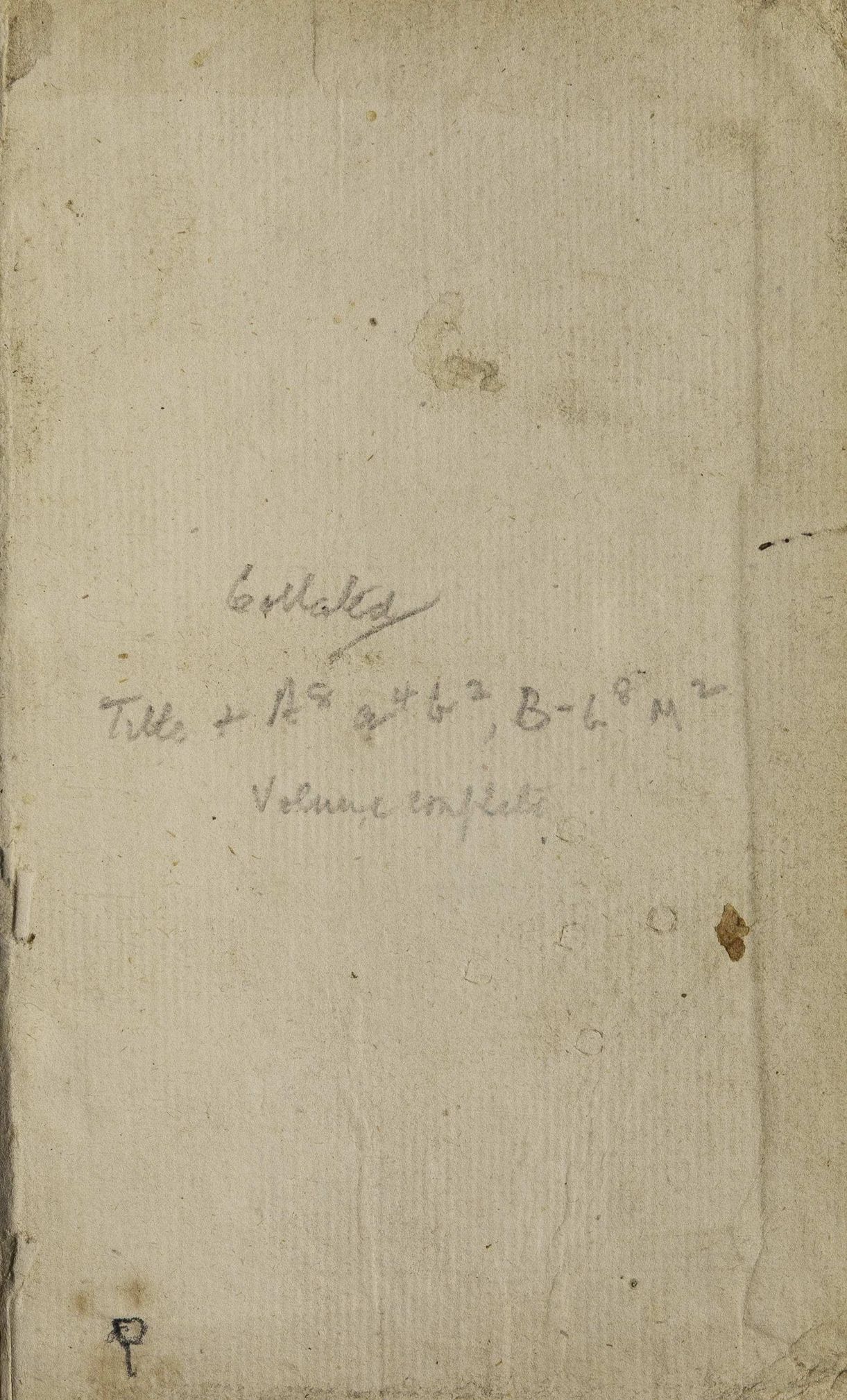
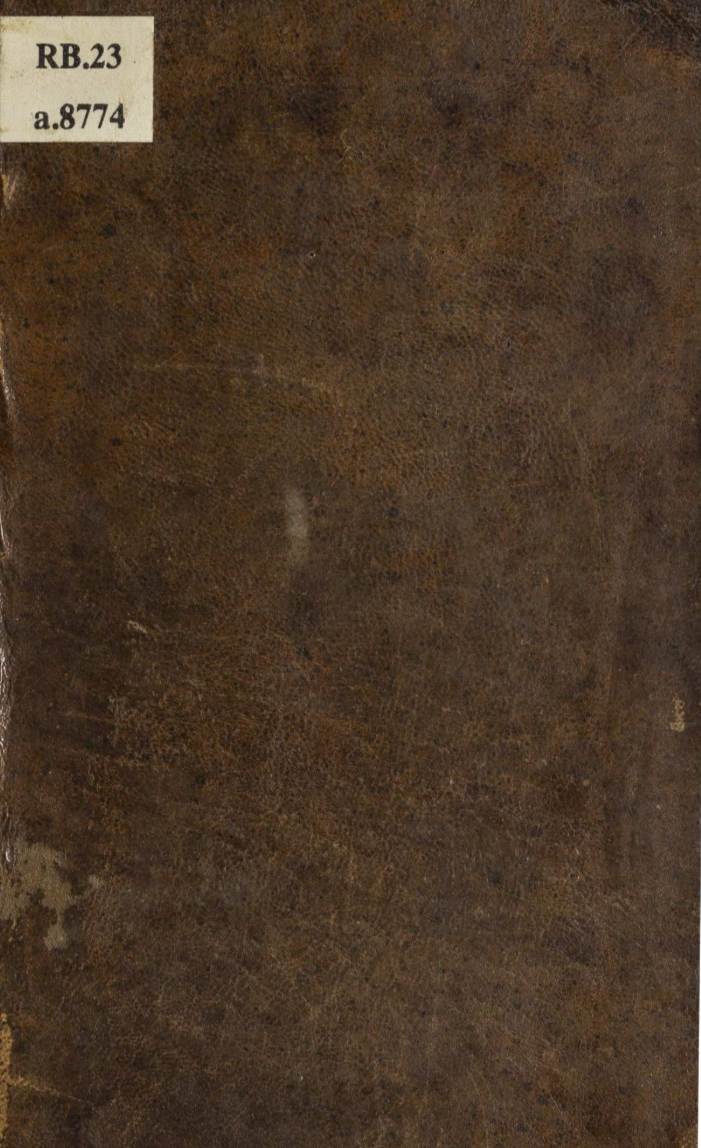
The author has written this book in complete anonymity. A scan of advertisements from the St. James Chronicle edition dated for the week of April 4–6, 1771, states that The Innocent Adultress was published the “Saturday last” prior to that week’s paper, implicating the release on March 30, 1771. The book was advertised as releasing across two “Pocket Volumes” priced collectively at five shillings. The cheap pricing and explicit mention of a smaller form factor for the physical book itself, both imply that The Innocent Adultress was intended to be a widely accessible work that was affordable irrespective of a prospective reader’s status, and was therefore likely to be produced with cheaper materials in order to enable the novel’s lower cost. There are two editions available for access from the Eighteenth Century Collections Online (ECCO) database. One appears to be a reproduction of the original printing including full scans of the folio binding; another is subtitled ‘A New Edition,’ dated for 1779. Both scans omit the entire second volume, ending during a loud declaration of adoration towards Harriet by the Prince while they are privately met in the Countess of D.’s home, which is cut short by an em dash, signifying a continuation of the dialogue in the second volume. Harriet’s characterization for much of the novel was framed around her inability to be persuaded towards the perspectives of those around her, even remaining steadfast in dismissing Lord Fillemore’s absence from her life, much to the chagrin of both the Prince and Countess. Not having context for how she responds to the Prince, an event in the story that is also significant for allowing the present court proceeding to concretely map the history of Harriet’s activities for which she is being judged, consequently makes reading what is preserved of the narrative a more unsatisfying experience.
There are two editions available for access from the Eighteenth Century Collections Online (ECCO) database. One appears to be a reproduction of the original printing including full scans of the folio binding; another is subtitled ‘A New Edition’ and dated for 1779.
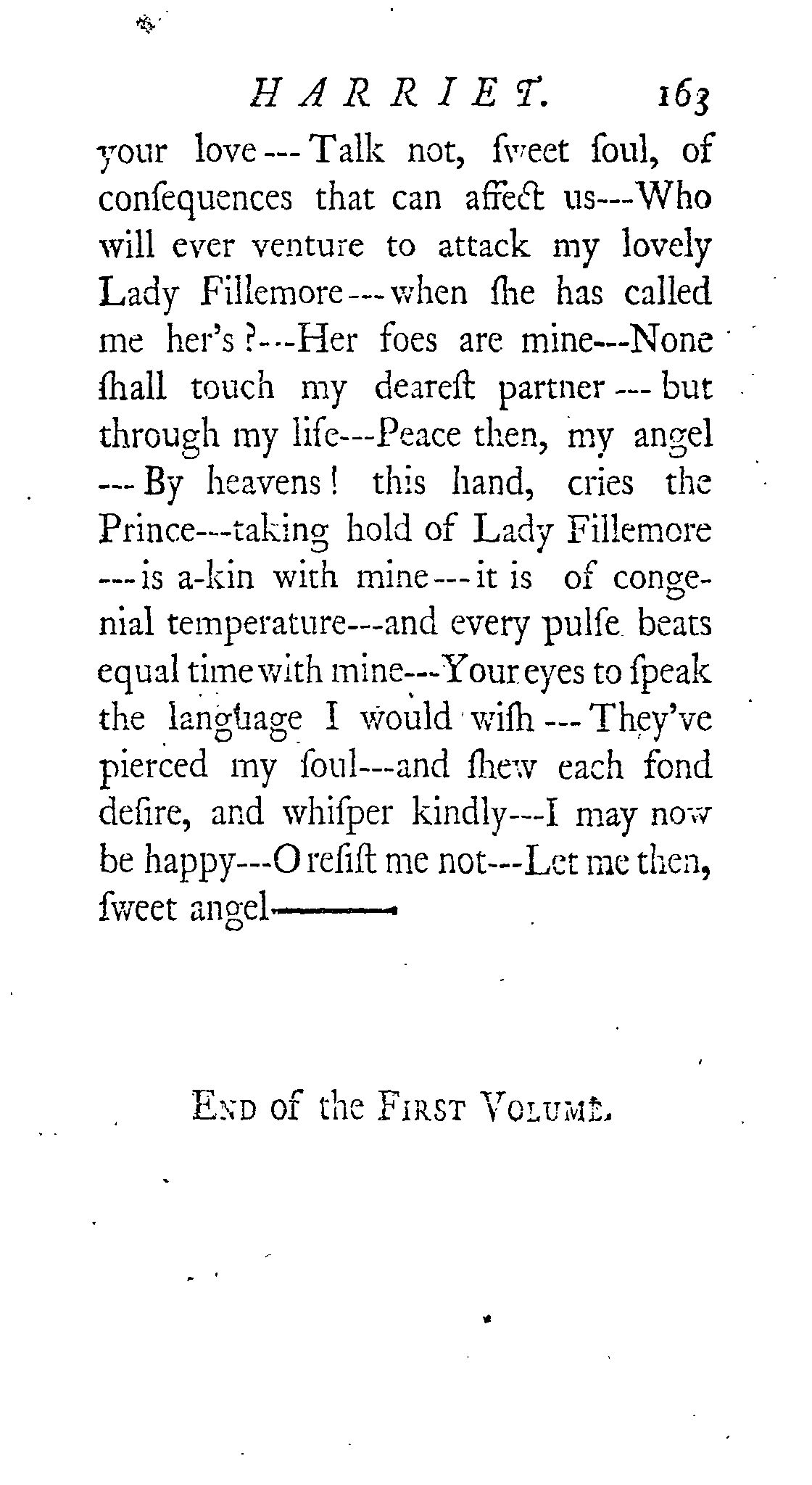
Both scans omit the entire second volume, ending during a loud declaration of adoration towards Harriet by the Prince while they are privately met in the Countess of D.’s home, which is cut short by an em dash, signifying a continuation of the dialogue in the second volume. Harriet’s characterization for much of the novel was framed around her inability to be persuaded towards the perspectives of those around her, even remaining steadfast in dismissing Lord Fillemore’s absence from her life, much to the chagrin of both the Prince and Countess. Not having context for how she responds to the Prince, an event in the story that is also significant for allowing the present court proceeding to concretely map the history of Harriet’s activities for which she is being judged, consequently makes reading what is preserved of the narrative a more unsatisfying experience.
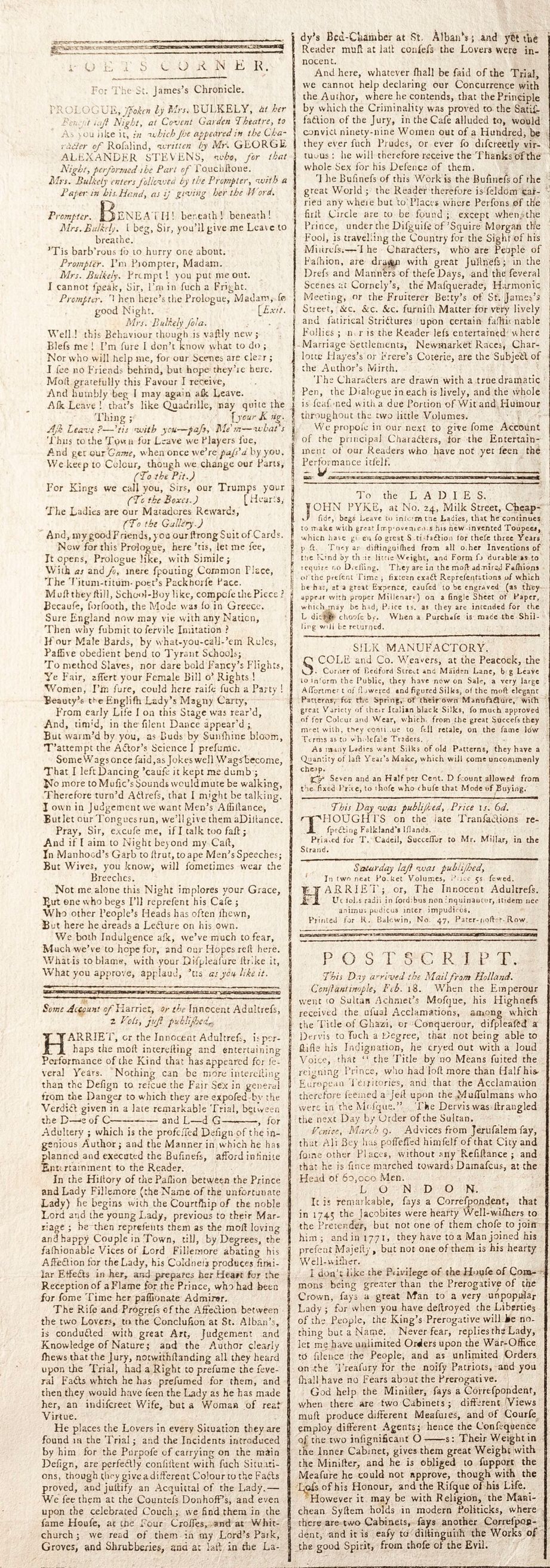

The sole advertisement for the book occurred in the same edition of the St. James Chronicle or British Evening Post. An account of the novel is featured in the “Poet’s Corner” column of the issue, which mostly provides an extensive synopsis of the story, but also spares its last two paragraphs to commend the author for the nuanced realism they colored their writing and characters with, going as far as saying “The Incidents introduced by him for the Purpose of carrying on the main Design, are perfectly consistent with such Situations.” (1771).
The second advertisement is located in a column dedicated to marketing for leisurely and practical services within the issue, and is far less prominent in presentation or space taken, relative to accompanying advertisements for products and pastimes such as the Silk Manufactory, a dedicated business for selling flowered and figured silks used in Spring clothing; or sales of toupees towards women by a man on Milk Street named John Pyke. The ad for The Innocent Adultress is comparatively simple, detailing its two-volume structure, price of five shillings, and crediting R. Baldwin as the publisher.
 Harriet, or, the Innocent Adultress